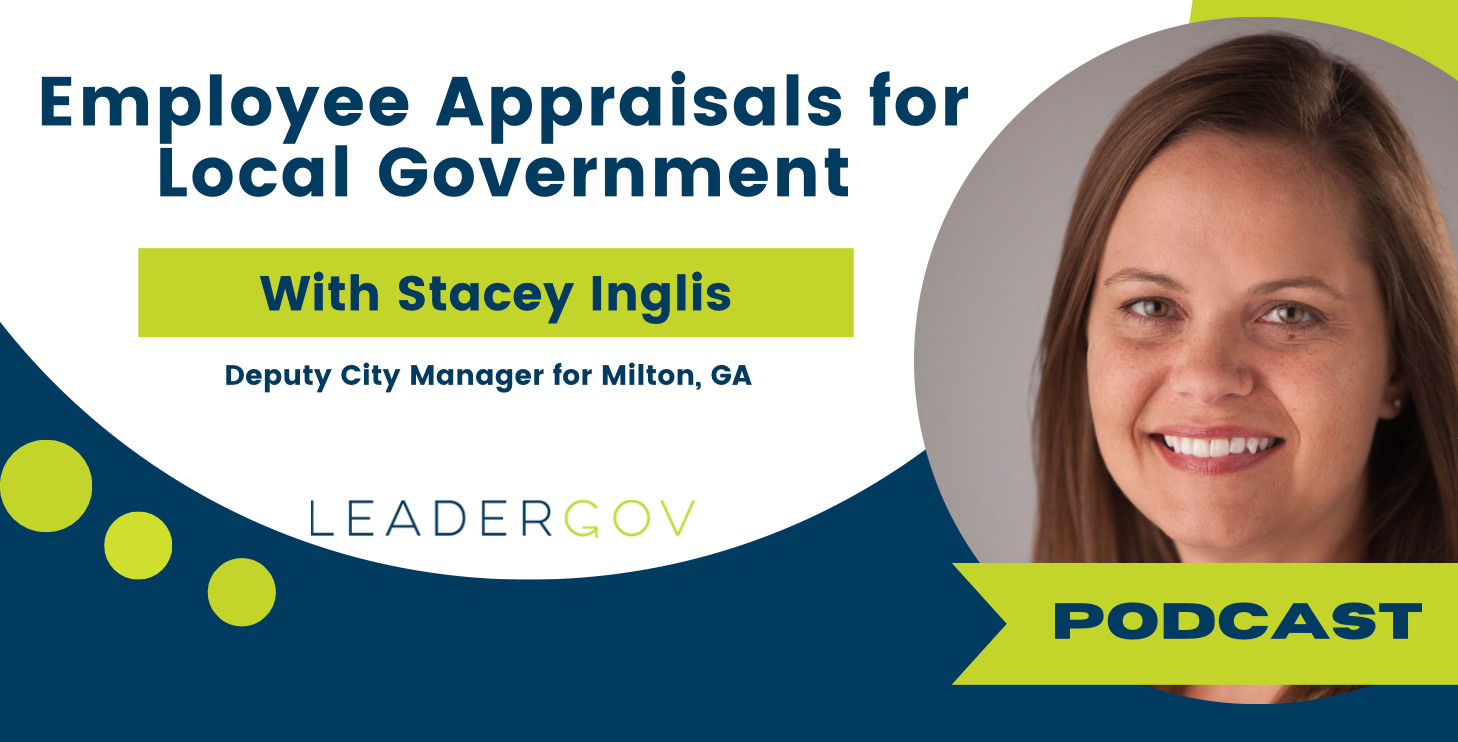
Listen and learn from the best in local government
At LeaderGov we want to equip you to lead well. These enlightening podcasts, from top local government and industry leaders, will help you gain valuable insights into a variety of leadership, management and teamwork topics, so you can lead better.
You can also listen to LeaderGov Podcasts via Apple, Google Podcast or Spotify.
Transcript
0:00
But yeah, we are really great to have. Just excited to have everybody on the
0:06
workshop today. This is actually going to be modified into a podcast as well. So so welcome to everybody. You know. The topic today is appraisals, and we really want to give you some ammo, some ideas to improve your employee appraisal Program. My name is Bill Stark. With me is Tim Fenbert, and so we're glad to be with you today and kind of facilitate this time together. We've got a special guest today who's a friend of ours and a really knowledgeable local government executive, so we're excited to hear from her, and toward the end of her sharing time of what they did in their city, we're going to open up the conversation for you to put questions in the chat, and we'll take as many as we can. We normally do a breakout at the end of these workshops where we put you in small groups, but we're not going to do that today. We're just going to have a little bit more time for Q and A at the end of the session today. So without further ado, I would like to introduce our guest today, Stacey Inglis. Stacey is the Deputy City Manager for the city of Milton, Georgia, and her focus is advancing strategic priorities in the city, strengthening organizational performance, delivering high quality services to the community. Stacey joined Milton in 2007
1:33
and she's really helped shape the city's financial and operational Foundation, implementing long range planning strategies guiding Milton's growth as a high performing local government and a lot of her work helped the city earn a triple A bond rating, which is kind of a big deal. I did want to get Stacy to say one thing off script in just a moment, I think you all won an award like one of the top customer service cities in the country. So I want to want to hear about that in a minute. But leadership roles. Stacy's also been with the city of Riverdale, Jonesboro, Clayton County Water Authority in the city of pooler here in Georgia.
2:17
Bachelor's degree in finance, masters from Georgia, Southern ICMA credential manager, graduate senior executive of University of Virginia's Weldon Cooper Center for Public Service, and she also serves with the Georgia City County Management Association. So
2:38
Stacy, great to have you here today. How's it going? Thank you so much. I am very honored to be here today, and I'm and I it's going great. So you're asking about the award that we got, or it was with polco, which is the surveying organization that ICMA uses to do the National Citizen survey, and so we used it. It was a statistically valid survey that was sent out to random people throughout our city, and it was compared to other cities across the United States, and we were number one in customer service of all the cities. And then having it that participate in this program. So we're pretty proud of that. Yes, yeah, well, that it takes a lot of effort. You know, that doesn't happen by accident, right? It's, it's got to be a real focus. And so congratulations on that. I actually found a news article. I was going to show it today, but I did want to at least mention it, because it's really quite a, quite a quite an accomplishment. Stacy, when everyone that's on the workshop today this appraisal topic answered two questions when they registered. And the first question that we asked everyone was, well, how well is your current evaluation process working? And the answer is the blue here, for those of you that on the podcast, I'll have describe it to you, but 47% of the folks says it works somewhat. But it could be more meaningful. That was 47%
4:11
17% said, well, it works well, and it supports employee development. That's good. About 16% said it mostly feels like paperwork. So we've heard that before, and then the green box is 19% said we're considering changes to our system and the way we do this. And so in other words, 83%
4:33
of the people said, gee, we kind of want to see some type of improvement. So I would love just to hear as we, as we kind of get started, does this reflect Milton a couple of years ago, when you all started that your project Absolutely, and we still fall into that category. We never sit back and say we're done. You know, it's, it's, it's still a work in progress. I mean, it's not perfect, yeah, so yeah, so we are still in one of those categories. Yeah, yeah, yeah.
5:00
Now the other question that we asked everybody was, what is your biggest challenge with your current process? And
5:08
8% said supervisors are not comfortable coaching employees, so that sounds like a training issue.
5:16
18% said the reviews focus too much on the rating itself instead of the development of the team member.
5:25
Let's see 23% said evaluations do not meaningfully improve performance. So which kind of gets to the question of, why are we doing this right? Why are we going to this trouble of having appraisals? Is it to tell them what status they are, or is it to give them a road map to higher performance. And then it looks like about 10% said goals are not well integrated into the process. So we do see this also as this divergence between goals and values, for example. And then lastly, 41% of people said, Yeah, we're we're just exploring improvements. We've got to change what we're doing. So anything stand out to you here? Stacey, I'd love your love your thoughts. If you see anything that's kind of interesting, particularly about supervisors not being comfortable coaching. That was actually a low number. Yeah, we ran into all of those issues, and that was what we tried to focus on. And yeah, supervisors not not being able to provide the evaluation or coach the employees. That was that was significant for us as well, but we fell into each one of those categories. And I think a lot of people to actually do,
6:38
yeah, I agree. You know, today, in our conversation for everybody that's with us, today,
6:46
we want to, Tim and I are just going to walk through a series of questions for for Stacy, and to kind of have her unpack or maybe relive the process that she went through with her team in Milton to sort of re engineer, redesign their performance management program. And so we're going to touch on topics like, what was the purpose of their effort? What were they hoping to achieve? What gaps they saw?
7:16
Did they get employee input in the process? Did they create a planning team? What resistance did they find in the process? Was City Council involved? Were they there or not there? And also this topic, Stacy of monetary rewards. I know that was, that's part of your program is a monetary reward. So we want to talk about that. Not every city or county can do that, or is doing that. And then also want to touch Be sure at the end, we talk about goals, because I know that your goal
7:48
management process is kind of a separate exercise, so I wanted to talk to you about that. And then just lastly, what's the overall benefit? Like? How is the city seen? Improvements, you know, from what you all put together. So that's kind of where we're headed today with our discussion. And
8:07
Tim, what do you think? Where should we start out here?
8:12
Well, Bill, you know, I think
8:15
this, this idea of purpose, is a great place to start. You must have
8:19
organized around some outcome that you were trying to achieve. So how did you connect the purpose? What? What was that process like? Stacey, so we had an objective that we created in the very beginning of this.
8:34
It was to create a performance management program that was based on best practices, and it was designed to motivate and engage employees and incentivize optimum performance, and that was the main focus. And this was, this was while we developed it in the city manager level, city manager's office, we took that before our council and got them to approve it before we even started the work with the committee. So we needed to have that that direction from the very beginning, because we didn't want to waste our time going down a road and not and not be something that the council was going to be excited and get behind.
9:19
Do you have a union? Was there a union element to any of this process? No, we do not have a union. Okay, I know many, some of the folks on this call, have that added layer. I just wanted to ask that question,
9:34
speaking of you know, I wanted to ask you about the gaps, like, what did you see? What was missing two years ago. Well, and how did that? How did that affect the city? Like, how did it affect performance and employee behavior? So appraisals, and I think this kind of goes across the board, kind of felt like a check the box exercise for us.
9:59
There was no.
10:00
Connection between, you know, the performance or increasing or incentivizing performance,
10:07
the expectations weren't. It was a weak connection with the expectations and in the evaluation, and there weren't, there were no rewards. You know, pat on the back was basically what you got for performance evaluation. So nothing was really driving performance. There was a lot of also inconsistencies between supervisors and between departments across the city. Some supervisors are easy raters, and some weren't so easy.
10:36
And
10:37
there was limited feedback provided to the employees throughout the year. You only get this one feedback once, once a year. And we wanted to to kind of shake that up a little bit. So that was, we knew that was a problem, and the last thing you want to hear is that you're not performing well one time a year, or that you're performing great one time a year. So we wanted to, we want to tackle that as well. Was it tied to compensation previously? I mean, did you do it at the time of changes in compensation, or was it completely always, completely separate?
11:10
Very early on, we're a newer city. We're in our 20th year now, and very early on, we did have
11:17
an evaluation program that was tied to compensation, but it was not meaningful. And then we kind of went away from that for a while, because that was also during the downturn in the economy, and so we couldn't afford it,
11:31
but we just really never came back to it.
11:35
We had other evaluations that were done, and at one point we decided evaluations just weren't meaningful enough. It was that check the box exercise, and so we stopped doing them for a couple of years, and then went to something that was more
11:50
forward, focused and goal driven.
11:54
So we can I'll talk about that a little bit later in the process, but that was some of the stuff that we didn't have it tied for a long time to pay.
12:05
Did you, as you all got started in this as a team? Did you What did you seek any employee feedback initially, or was that reflected in the core team that came together to solve this? Did you do any surveys, or anything like that? We didn't do any formal surveys. All of our stuff was more informal. It was conversations with employees. It was, you know, it was from the team that we did form for the for the committee. But it wasn't anything formal. We
12:35
that, you know, that was kind of the basis of what we had. Yeah, tell me about the team. I know that this was a, I think, a multi month process. You all went through. This didn't happen in three weeks, right? This was a multi month effort. But you had a kind of a unique team. It wasn't just all the department heads, right? Can you? Can you share a little about that? There were no department heads. Myself, I'm a Deputy City Manager. We also have another deputy city manager that works here and and we both were on the committee. The city manager was not but we purposely did not include department heads in this committee for multiple reasons. We we got
13:18
people from HR, I'm sorry. We've got people from police, fire, Public Works and parks and recreation,
13:24
and they were chosen by the department heads based on their credibility, their ability to be objective and their ability to think beyond their department as well as they were in good standing with their department, their peers looked up to them. So they were they were also ambassadors of of their department as well. Yeah, yeah, you mentioned police. I've got to ask the police question, the public safety question. And we hear this a lot
13:55
in your world, in the current evaluation system you have going now,
14:01
the dimensions or competencies that you've developed for the city. Are they different for staff, sworn versus non sworn? Or is it the same competencies, the same across the board, for every every position we we chose it that way
14:19
because it didn't matter the job that you have, the job the responsibilities that you do, what matters is how you do them, what what your behavior is while doing those functions, I know that
14:32
a lot of a lot of positions, especially public safety, do focus a lot on training that they have to have certain training in order to maintain their their accreditations, but ours, we said, well, there is a professional development core competency that we have, but we expect professional development across the board, and those expectations are also set in the developmental aspect.
15:00
This performance management program they put together so it we we chose not to differentiate between departments with with this evaluation, Stacey, did the team ultimately make the decision on what your program, how was going to be designed? Or did the team make recommendations to the city manager. What was the decision process? So the decision process, I mean, the team did design it, and then we presented it to the department heads to make sure that it was something that they could get behind as well, because you have to have that support. And obviously the city manager was a part of that.
15:40
And then we ultimately put it before the council. And while they didn't necessarily approve the actual program itself, they have to approve the financial aspect of it.
15:53
They they kind of gave an odd to make sure that, you know, we were on the right track with the with everything. So it was, it was a lot of multiple key stakeholders that kind of came into the process. But ultimately, I mean, it was, it was a committee that decided on the core competencies of the of the program. Wow, yeah. Speaking of, if you could just kind of give us an overview, I know we don't. We have limited time here today, but the team came together and they tackled various elements. They designed a new program. So I assume you may have redone or re tweaked your competencies, your values, you may have tweaked your rating scales a bit. You may have come up with a different feedback cycle, quarterly feedback, whatever. Could you just kind of walk through those major program elements and sure, no, this is kind of a big question for a short period of time, but just kind of an overview. Yeah, so the committee had several key things that they were looking at and considering,
16:56
one is just the project plan itself. I mean, you with a project plan, you've got to talk about timeline and you got to talk about tasks, but it's also but also you had to talk about risks and how to mitigate those risks, communication plan and the timing and method of communication that goes into it. So they they had input into all of that. They also looked at, what are we evaluating, meaning the core competencies? So they developed that, how do we rate, meaning the scale that we use who participates or who's eligible to be a part of this program, and
17:31
how do we ensure fairness, and how do we tie pay to it all? So they had input into all of that, and they all brought their unique perspectives into it. Because, you know, think departments like police and fire public safety departments are so vastly different. I mean, theirs is
17:51
incredibly different from what I do in my role, and so we needed to to make sure that we got their perspective, I mean, and their buy in.
18:02
And like I said, they were ambassadors of this whole program. They took it back to their departments, but the whole time, throughout the whole process, they kept providing feedback to us from from their discussions with their peers in their departments. Interesting. Okay, I love that. That's a good segue. So you mentioned communication plan. So all during this planning process, formulating all this stuff, sounds like there was some back and forth between, hey, here's some ideas, go, go socialize and come back. Is that part of the communication plan? Absolutely, yeah. What else did you all do? Did you give updates periodically to council? Or the we did, we was, it was, well, it was one final update to council, but we did provide, I think it was weekly status updates to the city manager. And then we also talked to the department heads along the way. We socialized it with them as well, but, but that was also the responsibility of the committee members to take it through their department heads to make sure that they were good with the direction we were going and and I believe the city manager may have also had conversations with the council through the process. I'm not, I don't really remember that piece of it, because this was three years ago when we were going through it, but they, I believe they had some information that was that was provided to them throughout process, but it wasn't anything formal in front of in front of the public, okay, were you able to, were able to kind of get ahead of, I say, gossip, not that people gossip in the city of Milton, but everybody knew that this team was formed, and everybody probably knew it was going To affect our pay.
19:41
It sounds like you use this some communication tools to try to mitigate misinformation. Shall I say? What? What happened? We did, and there was still some, but we did provide some communication. We'll send emails out, and like I said, the committee members would also talk to their peers within in the department.
20:00
Months, but you're still going to have, you know, the the concern from employees. Because especially whenever we were talking about tying this to pay, they that that brings a whole new level of concern from our from our people and and rightfully so. I mean, I get it, especially whenever you're not really a part of the process. You're just sitting back, waiting, trying to figure out what's going to happen to you. So it's you. We tried, as much as we could, trying to mitigate some of
20:29
the or get in front of some of
20:32
the the problems that you know, the challenges, the pushback that we have received. Yeah, what were, what was, what were some of the roadblocks? What was it employees? What, what fears or what, what, what things bubbled up that y'all had to kind of pay attention to?
20:47
Well, resistance to change is is always going to be a roadblock to any new thing that's coming your way.
20:56
Major concerns about fairness and biases that go along with evaluating, because it's a lot of times it's subjective,
21:05
and then supervisor readiness, because, you know,
21:10
just based on previous experience with their evaluations, supervisors didn't really receive a whole lot of training about how to do the evaluations and how to provide That feedback during the during that session with their employee. So those are the main concerns,
21:27
and we and we had to address those when we went through this process. I mean, we looked at, you know, we need to make sure that the supervisors were trained, but not only the Supervisors, also the employees. I mean, they had to get socialized in what the new process, product was going to be at the end of it, but also how to receive feedback,
21:50
you know, that's that's really difficult to, you know, to try to communicate to somebody. It's like feedback is a gift, yeah, but it's hard to get there, you know, because some people don't see it that way. So trying to create that culture of receiving the feedback and and taking that feedback and turning it into something constructive
22:13
is something that we we considered in the training when we were developing that as well. Yeah, yeah. Stacey, what were a few of the highlights of your system? Not in a lot of detail, but just what were some like, did you go from a one to five system to more of a development system? Just walk us through just what are the highlights of where you ended up. Just so everyone on the call kind of knows what the committee kind of finished with. Sure. So our previous system, if I remember right, it was on a think it was on a three point scale,
22:45
meets expectations, exceeds expectations, or does not meet expectations.
22:51
I feel like I remember that it's been a really long time since I've seen that, probably five years since I've looked at that we,
22:59
we also had core competencies. What we did, I can speak more to what we did instead of what we had previously. That's, yeah, what we what we ended up doing was we tied our core behavioral competencies to our core values of the city. So we had gone through the the process of creating a strategic plan and redefining our core values not that long before we did this, this committee design or the program design, and we wanted to make sure that we tied everything to the core values that we developed. And so all of the core competencies that we have roll up under our core values. And our core values are there are unique to Milton. They can be boiled down into what you normally see as core values, like integrity, teamwork, leaders, leadership,
23:53
innovation, things like that.
23:57
But that's what we ended up with. And we also wanted to make sure initially, and we did change it up. But initially we we designed it to where
24:07
everybody, every employee that were eligible for the program, every single employee, were rated on the same core behavioral competencies, and then, depending on your level of responsibility, you had additional core competencies that you were rated on. So you had, you know, your base employee core competencies, and you had manager level and department level core competencies. We ended up, after the first year, we went through an evaluation, we sent out to the survey to the employees and asked them what they what they liked and didn't like about the the evaluation or the program, and we got some really good feedback from that, and we kind of redesigned the core competencies because some of them were duplicative and some were too similar that there we couldn't differentiate between them. And so we kind of restructured.
25:00
Some of the core competencies, and
25:03
it was a lot. The what we had initially was was way too much, and it was, it was very cumbersome to get through the process, but that we ended up with a good product the second year we also, there was something else I wanted to say.
25:22
I lost it, but
25:24
we
25:27
wanted to
25:31
tie in, oh, the rating scale that we use. We ended up going to a five point rating scale, and we decided you cannot give half points because, like, it's a three and a half instead of a four or a three,
25:46
so none of that. It's a it's a 123, or four. One is it was needs improvement. Hold on, let me say, fucking remember exactly what it was. It was expectations not met. Is one? Some expectations, some expectations met is number two. Fully achieved. Expectations is number three, and number three is good. And we had to really drive that into our supervisors to make sure the end and the employees to make sure that they understood that we have high expectations for our employees performance here in Milton, and getting a three is is a good thing,
26:25
and then going on and exceeding expectations, and then exceptional performer. So we had that five point rating scale that we that we decided on. And then we also developed
26:39
a matrix, a performance level matrix that defined what each core competency was, what the performance level was for each that core competency. So it gave some examples, and so you could have some kind of guidance by the supervisors to be able to look at and say, okay, my employee falls here in this category. Yeah. Kind of described each category in some detail. Yeah, yeah, it's we've got time for a few more questions. I have three more questions I wanted to ask you, and then we want to get everybody on the Zoom today to chat questions to Tim in the chat, if you would like here, what I wanted to ask you was about you could just briefly explain the process you go through
27:23
to try to ensure fairness in the ratings, sort of a peer to peer idea of allowing other managers to see the ratings I'm giving my employees to kind of to be sure I'm thinking things through clearly. So that's number one. Number two is the idea of the monetary reward, right? This is not an increase in their base pay. It's a incentive bonus, whatever you want to call it. And then lastly, I would love to touch on goals. And kind of as a I know that's kind of a separate topic, almost from the appraisals, but just very quickly, how you all are treating employee goal tracking, so tell us about the peer to peer. It's what I call it, you know, evaluation process. We call it calibration, okay, and so it is.
28:14
I'll take police
28:17
first, and it differs from department, but you have the rank and file structure in police and fire, and so in police, we said, Okay, everybody who is a
28:32
sergeant, all the sergeants and above all come together in in one room, and They all go through each and every single evaluation and and wow. Sometimes employees change shifts, they change supervisors, and so you have multiple supervisors giving input on one employee's evaluation, and they get challenged. They have to the every evaluation has to have the rating, but also has to have an explanation for the rating. You can't just say anything for and above has an expectation or explanation. We said everything has to have a reason, a comment, something that provides some support for the rating that they received. And these supervisors have to defend their ratings with their peers. And sometimes they're challenged, sometimes everybody's pretty
29:25
good with it. And once the sergeant level is done with their review, then it bumps up to the next level, the captain level or Lieutenant level. And with the lieutenants, the sergeants leave the room, and the lieutenants do the performance evaluations that go through the sergeants that they had to rate, and then it keeps going up with the department heads. Once it got to the department head level, we would come across departments, and so police and fire may come together with HR and defend their department the.
30:00
Deputies that they had to do the performance of ih and other department heads that don't have that rank and file structure. They come together with other departments. It was cross departmental, and they each we tried to pair them up with people who work together a lot, so let's say Community Development and Public Works, and maybe even parks or rec I mean, those are some pretty big departments for us, and so they have a lot of cross interaction, and their department heads may have some interaction with each of the employees. And so it's we all try to make sure that everybody maintains that fairness and keep the biases out of it. So that is kind of what we do, the peer to peer, yeah. And
30:46
then we also, what was the next question was, well, it was about the monetary reward. This is not an increase in their base pay, right, correct? That was something that we had to consider, because there's advantages and disadvantages to did, to adding
31:01
it to the base pay, or to keeping it separate. And what the committee ultimately recommended, and the council supported it, was that we wanted to make sure that
31:13
it wasn't compounding year over year, because sometimes, whenever you add it to the base pay, the performance levels change from year to year, but also it can be a little more expensive, you know, as time goes on. And so we decided to do a one time it's bonus. Is a wrong word that you actually say in local government. So we call it merit incentive,
31:39
and it is a one time pay that's given to the employees in the middle of the year, and it's not added to the bonus pay. And that we had to also make it, make it meaningful. So it's
31:56
we needed to have an amount that wasn't, like $100
32:00
you know, we don't need to, like,
32:03
that's not that really that meaningful, yeah, lump sum payment. I see your comment. Thank you very much. Amanda makes sense.
32:12
So we, we needed to make sure it was it provided that incentive that people wanted to perform better in order to get the higher incentive. And so we have a decent like, the base amount for getting a three, any, anything between a three and a four, I believe, is, is $500
32:31
for for a base employee, and then it goes up to $1,500 for the next level, and then $2,000 so it's, yeah, it's expensive, yeah. But at the end of the day, it does provide that incentive, that that encourages employees to perform higher they know the level of expectation, that that that they have nice, yeah, that's good. Lastly, to tell us about your goal
32:57
process. I don't want to spend a lot of time on this, because we're we need to get some questions in here, but just that oftentimes we will see employee goals a part of the evaluation process. And that's not the case in Milton. It's kind of a separate exercise. Could you just kind of explain that? How y'all do that? Yeah, so that the goal setting process and the evaluation process are truly, true, truly two different types of conversations, and we didn't want to mix the two, because the goal setting process should be more positive. Well, that evaluation should be more positive too, but it's a little more nerve wracking, but the the goal setting process should be more forward looking and and should have multiple touch points throughout the year. So we call it our employee check in, and we have an initial check in at very beginning year where the SMART goals are set by the employee with the supervisor. And in that same exercise, we talk about how the supervisor can support the employee, either in the goals that they've set, or just in general, to perform well in their their job. And then there's a mid year check in to see how the employee is performing, if they're if they're getting making some progress on their goals. And then there's an end of the year check in. And it's not a static thing. They can't we'd say, you know, you can change up your goals in the mid year check in, because other things come about. You may have different goals and may have different responsibilities. You may have, you know, advanced more in the organization, and so that that goal setting exercise that you did in the beginning isn't really relevant to what you're doing anymore. So we have the three touch points,
34:48
beginning middle and end of the year, and at the end of the year check in. It's also wrapped into the next year's initial check in. So really it's two, but it's still, you know, periodic to.
35:00
Seconds throughout and that's kind of what we consider our developmental aspect of the performance management program. And we named it program instead of system because of the acronym that comes along with it. Instead of PMS, it's PMP.
35:16
Make sure that we
35:19
we had a good acronym to go along with it. Yeah.
35:23
And so that was the check in with the developmental and then we had the evaluation aspect, but also with the developmental aspect, that in the department head level, we are doing 360 evaluations, and we are considering those more developmental in nature, because at the department head level, you do want to make sure that you're being a good leader that your your employees need. And so we wanted their feed in their feedback, into their their 360 evaluation, yeah, yeah. It's interesting. The way you all have done this, there's so many variations and permutations to how a city or county could put these different elements together. And some things required, some things optional. And at the end of the day, it sounds like, though, a lot of training. And,
36:06
you know, getting people comfortable delivering and receiving the program was obviously a big, a big deal, because you got to roll it out and implement it properly, I suspect well, and I love to build the fact that you were opening, you still are open to improving it. I mean, you after a year, you did, you know, a survey work, and you made sure and you were willing to adjust it, because you probably didn't get it right the first time. It probably still isn't exactly right. Yeah, that's good. Nothing's ever perfect. One thing I did want to mention on the pay as well. So while we did this lump sum pay or merit incentive pay. This is separate from the market adjustments that we do each year. We still wanted to maintain the market adjustments, to maintain, make sure that we are,
36:52
you know, still keeping in the the salaries, in, in, you know, our field and in, obviously, cost of living, you know, keeps going up. I don't know if I've ever seen cost of living go down, so we wanted to make sure that that was separate from this process. And one of the things we we found in our research was that
37:14
tying pay to performance can put too much pressure on the system,
37:21
because, you know, you're messing now with somebody's, you know, livelihood, and in that puts a lot of pressure on the supervisors, especially to make sure that they're getting the most for their employees
37:36
whenever it's tied to their base pay, when it's a one time pay, It kind of frees them up a little bit and hopefully encourages them to be a little more truthful in their evaluations. Yeah, that makes sense. I have a question for our audience here, as we kind of shift over into questions, and here it is up on the screen, you can chat your answer. Okay, just use the chat to answer the question is, what is the weakest element of your current appraisal process that you want to address? So is it unclear dimensions? Is it a poor rating scale? Lack of coaching and touch points. Is a lack of engagement from the leaders?
38:19
Does it feel judgmental versus developmental
38:23
is a lack of technology. You're not, not integrating technology into the system. Is it? Is it goal integration, or is it something else? Number eight, so you're welcome just you can put in the numbers if you want, one, three and seven, or you can
38:37
give us a few phrases or words or whatever we would love to hear kind of what's, what's bubbling up for you, and as you think about this whole process. And we did have a question here too, Stacy from Siri Stenson, up in Maine, right? Vermont. Maine, not. Vermont, yeah, yeah. I mean. And he had to do with how long did the process take, like, from when you form the team to actually getting the approvals, and like launching it was that a six months? Was it three months? Was it a year? What was that like for us? It was
39:13
probably about a four month process for the developing the program, and that is from the point of taking it to council to get their nod to make sure that we are on the right track to forming the committee and then carrying it all the way through. So we presented it to council in April and and then ultimately did the final presentation in July. Okay? So, yeah, three, four months. Yeah, I am looking at these answers. Tim in the chat, and there are a lot of threes, threes, threes and sevens. Bill, yeah, yeah. Let me go back and just show this again. Three is lack of periodic coaching, yeah. And seven is integrating goals, yeah, yeah.
40:00
Yeah, so really, I wouldn't say overwhelmingly, but we'll do the statistics later for everybody, and we're going to publish this back out in a blog or something later, but we want to capture your kind of present state, if you will, and we'll publish this back out to you all with a summary of this podcast, this workshop,
40:20
and this is consistent with, you know, the problem may not even be your appraisal system. I mean, it could be better, but you got what you got. You know, maybe you just need to do a better job of training people and getting people comfortable with coaching and, you know, making sure they know they're doing a three and a four. And it's interesting. I think the process that Stacy talked about the change, plus the coaching element or the training element, are two aspects of successful implementation. That one, you know, one won't be successful without the other, for sure. Yeah. Any other questions? Here you all are welcome to
40:59
oh, here we go. Here's another question, how much time is devoted by programs to review evaluations given the cross? Oh, yeah, that's a good question. How much time was devoted
41:09
programs to review evaluations given the cross, departmental name, peer to peer piece, yeah. How long did that take? Was that a add a few weeks to the process? Stacy, it does. So this process, we have a self evaluation piece of it too. I didn't really mention that, but we do have a self evaluation that does not look like the evaluation itself. We wanted to make sure that the employees were not doing their self evaluation based on the same rating scale and the same core competencies, because sometimes they don't align, and that can be a different conversation, but, but we start
41:44
that self evaluation process in February, and then it moves into the evaluation process
41:53
in March, March timeframe we're in the process of doing the calibrations now. So calibrations take a few weeks, because you got to get everything
42:03
scheduled with all of everybody's busy schedules, especially around spring break, because it got pushed a little bit this this year and and then after the after the calibration sessions, then it comes to the city manager's department. So our office will review everything. We see it all in a big spreadsheet to make sure that we're still making sure all departments are kind of in line with each other. There's not any kind of outlying departments in all of this. And then we push it back down to the departments, and they give the evaluations to the employees. So employee is the last person to receive it through this whole process. And so that happens in May. So it is a lengthy process from beginning to end. Stacy, where was the peer to peer piece in that is that happened in March, calibration. It's in April, the calibration. Okay, that's part of the calibration process. Gotcha? Yeah, I can tell. I just would like to
42:59
close, just with it, with a comment here, just hearing you speak, and we've talked a little bit already about your process, I have to really give you, give you all kudos, because, you know, to do something this important, it requires a lot of energy, a lot of time, a lot of thought, a lot of dedication, and even implementing it is not a, not A light lift. It's a it's a significant you know, and it just seems to me that what we as leaders put focus on is what we get.
43:30
And you all have, clearly, as a city, put focus on this element because you believe it's important right to to get have employees rowing in the same direction and understanding how they're supposed to behave. And I'm just amazed at the amount of work that went into this, but it's worth it, because you're getting a result at the end of the day. Absolutely yes. Casey, speak to some specifics, what has changed as a result of this effort?
43:59
Well, the main goal, remember, the main objective was to design a program that incentivized high performance and and we, I did go back, and we only have two years worth of data, but I did go back and look at the second year's evaluations, the average rates ratings that were given to our employees, to see if we actually accomplished that, Just in the, in the, you know, the two years that we did it and we did it was a small percentage increase in the ratings that were given, but we'll take that as a win. So we did, we did, and we're in the middle of it right now. So I you know, that is one thing that we are looking at year over year to make sure that, you know we are in the performance level is going up each year, it or not decreasing. I mean that you know we definitely don't want that to happen, but we do want to maintain at least
44:55
so trying to quantify something that sometimes is difficult to quantify.
45:00
Yeah, I'm sure Council is interested in that. For sure they are. I mean, and, and one of the things too, that we had to consider talking about Council as they have to approve this in the budget every year, and this is something that it there was no force ratings. We we don't we do have a budget, and we tried to get kind of the chicken and the egg, right? Yeah, we, we try to, you know, have enough of a budget to where we aren't forcing any ratings. There's not a set budget for each department saying you've got to live within this budget. We can, we can do a budget amendment, but
45:39
whenever you do have those high, high ratings, we want to make sure that you're justifying those high ratings.
45:46
But it that was one thing that we didn't want in this program is, is to have something that we said we have to live within this amount of money.
45:55
I mean, obviously that can change year over year, if at some point we come to where we're we're really title money. We we may have to do something with those incentives. Hopefully that doesn't come anytime soon, but you never know what the economy is going to do. Yeah, right. You don't want to become an entitlement program where I've gotten, I've gotten this bump last three years. I didn't get it this year. I'm entitled to that.
46:20
Hey, one last question from the audience here. Would you be able to share an example of a self evaluation question?
46:30
Yeah, I thought that was an interesting comment you made. That's a good question. Valerie,
46:35
yeah, pull it up.
46:41
Sorry, I didn't have this pulled up before you asked the question. Give me just a second. Yeah, no problem.
46:49
Hey, while you're looking like while you're looking for that, Stacey, take your time. Okay, because I want to show something real quick. Okay, so take your time. I want to show everybody that's on the call today,
47:03
real quick, something that Tim and I have put together. It's a road map for helping you get to where you want to be with your appraisal program. It includes, it's a six video series, plus consulting engagement. And so in this video series, we talk about options around dimensions, options around rating scales,
47:27
feedback, feedback. Options how to integrate goals, how to create, how to integrate a career, forward looking career plan, coaching, technology. So we put together a program for you all that are sort of interested in
47:44
tweaking, remaking your your system, and it's we tried to make it kind of modest. So it's $1,500
47:53
for your city to go through these videos with these engagements, these two consulting engagements. And if you want to know more about this, you can just email me, Bill at leader, gov.com,
48:07
or you can scan the video. We've got a little landing page and a video here that explains what this is,
48:13
or just stay on at the end of the call today, and we'd love to talk to you about any particular part of your appraisal process program that you want to modify. We'd love to help you, if we can, if, if you, if this has been helpful today, in and of itself, that's great also, but I wanted to Tim. Tim always, you know, makes fun of me because I have to get a sales pitch in at the very end. So I guess I earned my keep today. So anyway, finish your finish your comment. There, Stacy, and then we'll wrap up. Yeah. So our self evaluation is only three questions. We asked the employees, did you have any special achievements or accomplishments during the evaluation period? Because a lot of times the supervisors, we may not know all of the things that our employees have accomplished. And so we give them the opportunity to kind of brag on themselves a little bit. The next question is, we list the core competencies, and we ask them, what we find that what they find to be most challenging during the evaluation period. And our evaluation period is one year. It's March to March. And so we ask them to explain why they find that, that that one or multiple of them challenging, and we do not accept nothing's challenging for me, I can do all of them, or I'm not excelling all of them. We all have challenges with us. And then the next question is, what areas, based on the core competencies Did you excel at? So again, it's kind of your your way of you know, kind of bragging on yourself, but but also being a little honest in what you find challenging. Because that challenge that you may have could turn into something that you're.
50:00
Supervisor could support you in and provide resources for, yeah, I love that. That's, that's great. Yeah, I like the way it's, it becomes almost so it's a little transparency, but it's also kind of aspirational. And, you know, hey, I did some things I think I should share, right? Yeah, kind of take up for yourself. Well, thank you so much for your time today and sharing all of your your your journey, your your roadmap with some of the folks from across the country today. Really do appreciate it. You all are very dear to us. We love Milton and have enjoyed having you all in our orbit for a few years here. So thank you for for being with us today. Well, thank you very much for asking me. I'm again, honored that you even considered it. I appreciate it. Yeah, yeah. And so for anybody, if you would like to just hang on after today's workshop, you're welcome to otherwise. We hope you have a great weekend. Our next workshop is going to be on AI, local government, good uses for artificial intelligence and local government. And that's going to be Tim, I think, in the month of June, maybe or late, yeah, we'll post it on the website, probably first part of next week. We'll have a have an announcement on it, but we'd love to see everybody. It's a great topic, we're gonna have great another expert, because Bill and I are not experts on AI, for sure, it will be someone younger and more innovative than Bill.
51:32
Thank you, Stacey, you're welcome. Thank you. All right, you bet. Take care. You.